
Plant Beverage OEM Raw Materials: Puree, Concentrate and Enzymatic Extracts Compared
Plant beverages involve the widest range of raw material forms of any format. A dendrobium drink or a sea buckthorn juice can be built from puree, from concentrate, from an enzymatically treated extract, or reconstituted from an instant powder. Those four routes differ completely in cost, process difficulty, flavour fidelity and stability, and they also dictate the downstream sterilisation regime and shelf-life design. Projects that leave the material form undecided at the formulation stage tend to cycle through sampling rounds and lose control of cost. This article compares the four.
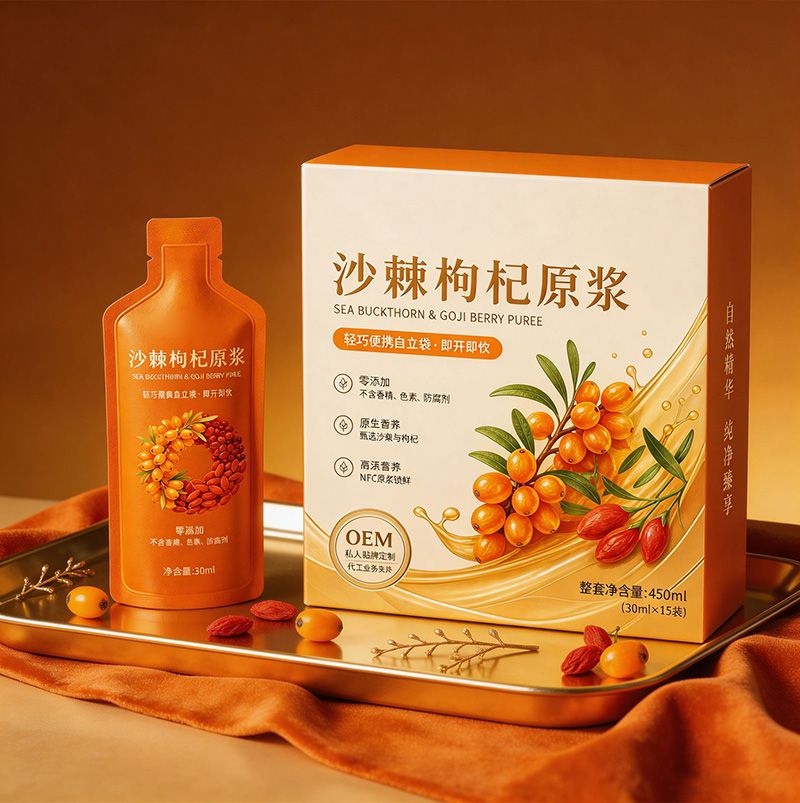
1. Puree: best flavour, highest cost and variability
Puree is the material obtained after pulping, optional filtration and pasteurisation, typically running 6 to 14 Brix. Its advantages are real: the flavour is closest to the fruit, the ingredient list is short, and being able to state "puree" on the label carries marketing value.
The costs are equally real. Low solids means shipping water, so both cold chain and ambient storage are expensive. Batch variability is significant because maturity, origin and harvest year show up directly in sugar-acid ratio, colour and viscosity - the formulation has to be able to absorb that variation or the same product will taste different across runs. And the microbial load is high, needing a more aggressive kill that then damages the flavour you paid for.
Acceptance testing for puree should cover soluble solids, titratable acidity, pH, colour, viscosity, total plate count and yeast and mould, plus pesticide residues and heavy metals where relevant. Sugar-acid ratio is the composite indicator that best captures batch-to-batch drift and is worth testing routinely.
2. Concentrate: the industrial compromise
Concentrate is produced by vacuum evaporation, typically to 40 to 70 Brix. Logistics cost drops sharply, consistency improves because evaporation has a levelling effect, microbial risk falls thanks to osmotic pressure, and storage life extends considerably.
The penalty is flavour. Evaporation strips volatile aroma and degrades some heat-sensitive components, so concentrated systems normally need aroma recovery or a natural flavour top-note to restore the profile. When specifying concentrate, fix the concentration factor and the reconstitution ratio, and check that the solids and acidity after reconstitution actually meet the formula.
Key acceptance items are Brix, titratable acidity, pH, colour value, transmittance for clear products, hydroxymethylfurfural, and microbiology. HMF is frequently overlooked but very informative: an elevated figure tells you the material was overheated during concentration or storage.
3. Enzymatic extracts: getting the actives out
Enzymatic treatment uses cellulase, pectinase or protease to break down plant structure. It serves two purposes: raising the extraction yield of target compounds by breaking cell walls, and reducing viscosity to improve filtration and clarity.
The controlling parameters are temperature, pH, enzyme dosage, reaction time and the deactivation step. Under-treatment leaves low yield and poor clarity; over-treatment generates bitter peptides in proteolytic systems or strips the flavour thin. Deactivation has to be complete, otherwise the product keeps reacting in the pack and develops haze or sediment during shelf life.
Besides routine chemistry and microbiology, acceptance should check residual enzyme activity to confirm deactivation, and molecular weight distribution where a functional claim depends on a particular fraction.

4. Instant powder: cheapest to handle, weakest on flavour
Spray-dried or freeze-dried powders win on logistics, storage and formulation flexibility: ambient storage, minimal space, accurate dosing, excellent batch consistency and immunity to harvest season. They suit stick-pack reconstitution products and work well as a flavour or functional component within a blend.
The downside is flavour. Spray drying carries off most of the volatile aroma, and it generally requires a carrier such as maltodextrin, which introduces an ingredient the label has to declare and complicates any "pure" positioning. Freeze drying preserves flavour far better but at a cost that only high-priced products can carry.
Acceptance items include moisture, typically below 5 percent, solubility and dissolution time, bulk density, colour, microbiology, and confirmation that the declared carrier ratio matches what was supplied.
5. Reconstitution maths that people skip
Whichever form you choose, do the reconstitution calculation before quoting. If the target finished product is 10 Brix and the concentrate is 60 Brix, the theoretical inclusion is around 16.7 percent by mass - then subtract the solids contributed by sugar, acid and stabilisers. That number drives the formula cost, and it is where negotiations with a plant most often go wrong: concentrate looks expensive per kilogram and can still be cheaper than puree per finished litre.
6. Acceptance and retention
Build a form-specific checklist. For puree, weight sugar-acid ratio, colour and microbiology. For concentrate, concentration factor, HMF and transmittance. For enzymatic extracts, residual enzyme activity and molecular weight distribution. For powders, moisture, solubility and carrier ratio. Retain samples from every lot and observe them alongside the finished goods through shelf life - it is the only way to attribute a problem to a material months later.
Plan around seasonality too. Botanical materials vary in price and specification by harvest and origin, so locking annual volumes and price bands ahead of the season, and requiring origin and lot traceability from suppliers, removes a lot of avoidable volatility.
For brand owners, raw material selection in plant beverage OEM is one of the highest-leverage decisions in the whole project. It sets cost, flavour, process difficulty and what the label can say, and it deserves real argument before sampling starts.
Related Products
Milk Thistle, Kudzu & Turmeric Beverage with Sea Buckthorn Puree & Honey | Herbal Oral Liquid OEM | Liquid Fruit & Vegetable Salad Fiber Drink | Dietary Fiber Meal Replacement Vegetable Juice Beverage OEM
About Guangzhou Mesen Health Biotechnology Co., Ltd
Guangzhou Mesen Health Biotechnology Co., Ltd is located in the Huashan Science and Technology Park, Huadu District, Guangzhou. The company has focused on OEM and ODM services for the big health industry for nearly 20 years, operating dedicated research, production, sales and management centres, and maintaining long-term strategic partnerships with well-known Chinese medicine colleges and research institutions. Capabilities span pressed candy, gummies, capsules, solid beverages, herbal teas, plant beverages, protein powders, dietary supplements and enzyme jelly - from formulation development through contract manufacturing. For details on minimum order quantities, sampling lead times and quotations, see our manufacturing advantages and product range, or contact us for a tailored proposal.
Further Reading




