
Plant Beverage OEM Equipment: Extraction, Homogenising, Deaeration and Filling Parameters
Plant-based drinks sit at the harder end of liquid manufacturing. Unlike clear beverages, puree-based systems carry pulp fibre, protein, pectin and polyphenols, which makes them complex and inherently unstable: sedimentation, browning and swollen bottles appear readily. Roughly half of those defects originate in the formula and half in equipment and parameters, yet brands tend to focus on what goes in and overlook that the same formula run on two different lines can differ by six months of shelf performance. When selecting a partner for plant beverage OEM, line configuration deserves the same scrutiny as formulation capability.
1. Extraction: trading temperature against time
Extraction moves soluble material into the water phase, governed by temperature, time and solid-to-liquid ratio. Higher temperature raises yield and speeds dissolution but accelerates degradation of heat-sensitive compounds and browning, since polyphenols oxidise and polymerise under heat and darken the liquor visibly. Typical windows: roots and rhizomes at higher temperature for longer, around 85 to 95 degrees for 40 to 60 minutes; flowers and leaves lower and shorter, 70 to 80 degrees for 20 to 30 minutes, preserving aroma and colour. Vessels should have jacketed temperature control, circulation and agitation to keep the mass uniform; ultrasonic or enzymatic assistance can raise yield at lower temperature where available. Filter and cool promptly afterwards rather than holding the extract in the hot zone.
2. Refining: colloid mill and high-pressure homogeniser
Pulp particles and fibre are the main source of sediment. A colloid mill shears coarse particles down, acting as preparation for homogenisation, but it is the high-pressure homogeniser that determines particle size distribution: material forced through a narrow valve at pressure undergoes shear, impact and cavitation, reducing particles to the micron range. Plant drinks are usually homogenised in two stages - a higher first stage around 20 to 40 MPa to break particles, and a lower second stage of 5 to 10 MPa to disperse and prevent reagglomeration. Higher is not automatically better: excessive pressure disrupts part of the colloid system, raising viscosity unexpectedly, and pushes energy and maintenance cost up sharply. Homogenising temperature is generally held at 60 to 70 degrees, below which viscosity rises and the effect weakens.
3. Deaeration: often skipped, rarely with impunity
Vacuum deaeration is treated as optional in many plants, yet its effect on stability is substantial. Dissolved oxygen causes three problems: it drives polyphenol oxidation and browning, accelerates degradation of vitamins and similar compounds, and forms bubbles during filling and sterilisation that upset fill accuracy and seal integrity. The principle is to spray or film the liquid inside a vacuum vessel so dissolved gas escapes, typically at minus 0.06 to minus 0.09 MPa and 50 to 60 degrees. Where a product repeatedly darkens, loses flavour or shows bubbles clinging to the bottle wall while formula and sterilisation check out, missing or under-specified deaeration is the usual culprit. The equipment is inexpensive for what it delivers.
4. Sterilisation: balancing parameters against flavour
The sterilisation method sets both shelf life and flavour retention. Ultra-high temperature treatment is hot and brief - 135 to 140 degrees for a few seconds - thorough, enabling ambient storage and long shelf life, but harder on flavour and colour and expensive to install. Pasteurisation at 85 to 95 degrees for 15 to 30 minutes preserves character better but usually needs cold chain or an acidic matrix. Acidic plant drinks below pH 4.6 can be treated at lower intensity; low-acid products above that threshold require a much more severe process. Establish pH and target shelf life first, then derive the sterilisation parameters - reversing that order is a common and costly error.
5. Filling: hot fill, aseptic cold fill, or conventional
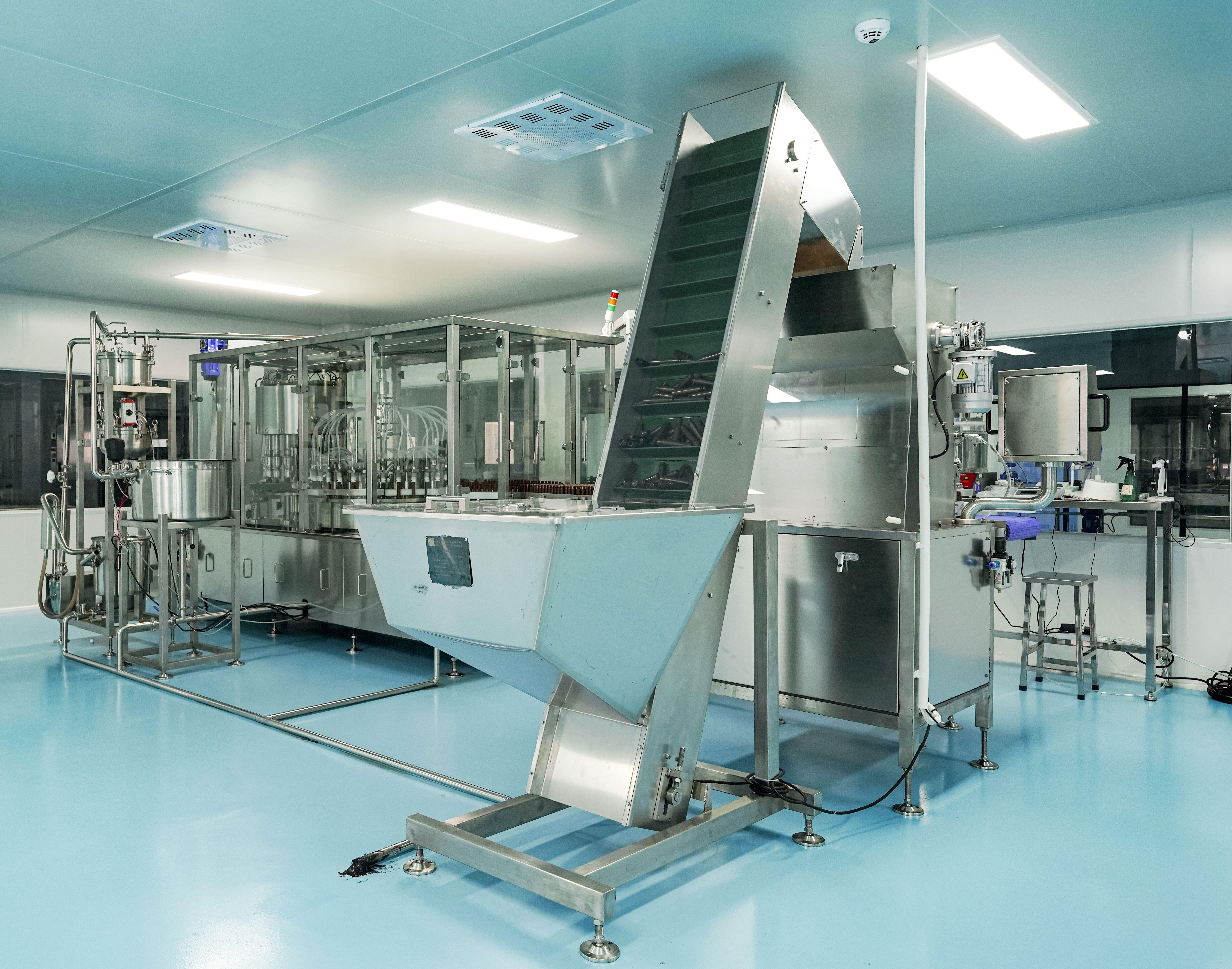
Filling method determines how far a product can travel. Hot filling is the plant-drink standard: product goes into the bottle above 85 degrees, the capped bottle is inverted so residual heat treats the closure and neck, and cooling generates a vacuum. Equipment cost is low and the process well understood, but bottles must tolerate heat - PET needs a heat-resistant grade - and flavour takes some damage. Aseptic cold filling runs ambient product in a sterile environment, preserving flavour best and allowing standard PET, yet the capital and cleanroom requirements are far higher, suiting large single-product volumes. Conventional filling followed by retort sterilisation suits glass, at the cost of energy and breakage losses. None is universally better; the choice follows order size, positioning and budget.
6. Supporting systems: CIP and instrumentation
Cleaning and monitoring are consistently underestimated. Protein and sugar residues in pipework and tanks form biofilms if cleaning is incomplete, becoming a persistent microbial source. A proper line carries clean-in-place with an alkaline wash, acid wash and rinse sequence, verified periodically by swab testing. On instrumentation, inline refractometers for soluble solids, plus pH and level sensing, catch deviation before filling and avoid reworking a whole batch. The completeness of this supporting equipment usually says more about a plant's real capability than the specification of any single machine.
Related Products
Milk Thistle, Kudzu & Turmeric Beverage with Sea Buckthorn Puree & Honey | Herbal Oral Liquid OEM | Liquid Fruit & Vegetable Salad Fiber Drink | Dietary Fiber Meal Replacement Vegetable Juice Beverage OEM
About Guangzhou Mesen Health Biotechnology Co., Ltd
Guangzhou Mesen Health Biotechnology Co., Ltd is located in the Huashan Science and Technology Park, Huadu District, Guangzhou. The company has focused on OEM and ODM services for the big health industry for nearly 20 years, operating dedicated research, production, sales and management centres, and maintaining long-term strategic partnerships with well-known Chinese medicine colleges and research institutions. Capabilities span pressed candy, gummies, capsules, solid beverages, herbal teas, plant beverages, protein powders, dietary supplements and enzyme jelly - from formulation development through contract manufacturing. For details on minimum order quantities, sampling lead times and quotations, see our manufacturing advantages and product range, or contact us for a tailored proposal.
Further Reading




