
Preventing Separation in Plant Beverage OEM: Homogenisation, Particle Size and Stabiliser Choice
Plant beverages are among the most separation-prone of all soft drink categories, because the system is multiphase by nature. Plant protein particles, pulp fibre, oil and an aqueous phase coexist, and any density difference between them separates slowly under gravity. A consumer opening a bottle that has stood for months, finding clear liquid on top with sediment below or an oil ring at the neck, assumes it has spoiled even though the microbiology may be perfectly sound. Preventing separation is not a matter of adding more stabiliser and hoping; it requires working three lines at once, reducing particle size, narrowing the density difference and raising the viscosity of the continuous phase. In our plant beverage OEM work, stability verification is a gate before a formulation is signed off rather than a repair carried out after launch.
1. Why it separates: settling and creaming
The classic description of a particle settling in a liquid is Stokes law: velocity rises with the square of particle diameter and with the density difference between phases, and falls as the viscosity of the continuous phase rises. Those three variables point directly at three routes, and particle size dominates, because halving the diameter quarters the settling rate, which is why homogenisation is usually the most effective single step. Creaming works the same way: fat globules that are too large aggregate into an oil ring. A third mechanism is not settling at all but flocculation, where protein loses its charge repulsion near the isoelectric point or at high ionic strength and aggregates into flocs or a gel. That behaves differently from gravity settling and needs a different response, so the first task is always to identify which mechanism is at work.
2. Homogenisation: pressure, passes and temperature
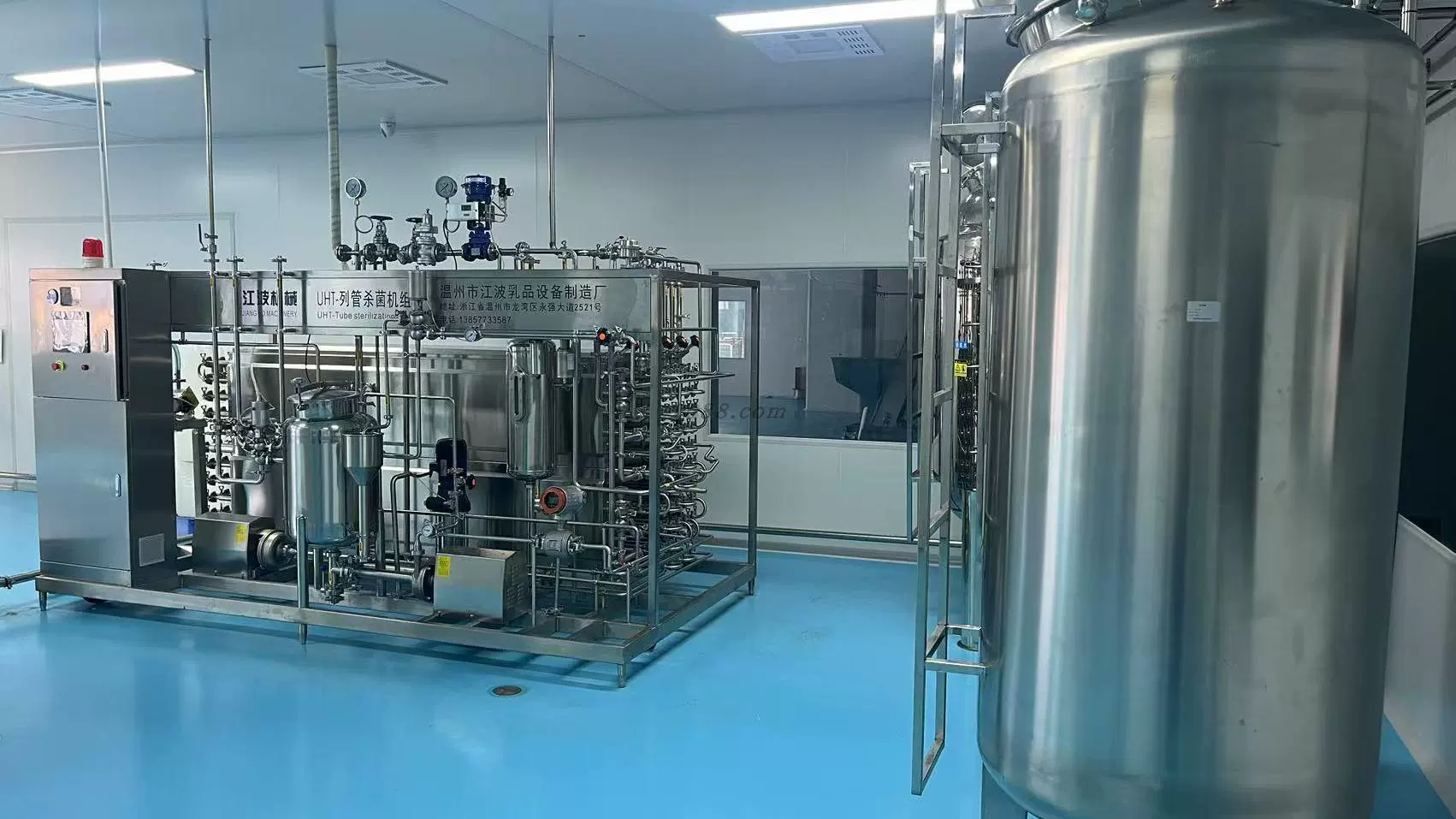
Homogenisation breaks particles and fat globules down and disperses them evenly. Pressure is the central parameter: higher pressure gives smaller particles but with diminishing returns, and very high pressure raises energy use and wear, and can shear protein into aggregates. A two-stage arrangement is usual, high pressure first to break, lower pressure second to disperse and prevent re-agglomeration. One or two passes are typical, since further passes add cost for little gain. Temperature matters too: too cold and the high viscosity blunts the effect, too hot and protein may denature, so the choice sits inside what the formulation tolerates. Results must never be judged from the set pressure alone, because worn valve seats make actual performance far worse than the gauge suggests, a common finding on ageing equipment.
3. Choosing stabilisers and emulsifiers
Stabilisers raise the viscosity of the continuous phase or form a weak gel network that holds particles up; typical choices include carboxymethyl cellulose, xanthan, gellan, guar and microcrystalline cellulose. Emulsifiers act at the oil-water interface, lowering interfacial tension and keeping fat globules apart; mono- and diglycerides, sucrose esters, lecithin and sodium caseinate are common. Selection is not a matter of piling in whichever works best, but of reading the system. High-protein systems need attention to protein-polysaccharide interactions, which can cause phase separation or flocculation. Acidic systems need stabilisers that resist hydrolysis at low pH. Systems containing calcium must avoid certain hydrocolloid reactions. Blends usually outperform single agents, but compatibility and ratio have to be confirmed in small trials, because indiscriminate stacking only raises cost and leaves a gummy mouthfeel.
4. Characterisation: size, zeta potential and spin testing
Watching a standing sample is too slow for development, so faster judgement is needed. Laser diffraction gives particle size distribution, and what matters is not the mean but the width of the distribution and the coarse tail, since a small population of large particles usually settles first. Zeta potential reflects the strength of charge repulsion between particles; the higher the absolute value, the more stable the system, and it matters particularly in acidic products. Accelerated centrifugation is a common screening tool, raising the effective force to produce sediment or a change in transmission quickly and ranking formulations within hours, though the correlation with real storage should be checked against real-time retains. Viscosity, pH and soluble solids should be logged at the same time, as they describe the state of the system.
5. Order of addition and preparation detail
The same formulation can behave differently depending on how it is made. Stabilisers must hydrate fully, usually by pre-blending with other dry ingredients and dispersing in hot water under high shear to avoid fisheyes, since a clumped hydrocolloid rarely dissolves completely even with prolonged mixing and leaves visible gel particles. Acid addition order matters too: acidic ingredients should go in slowly after the hydrocolloid has hydrated, with vigorous agitation, to avoid local pH collapse that flocculates protein. Homogenisation usually follows standardisation and pH adjustment and precedes sterilisation, and where post-sterilisation particle growth or recontamination is a risk, homogenising after heat treatment should be considered. Pumping and transfer matter as well, because high-shear pumps over long pipe runs can destroy a structure that has already formed; such details explain many cases where bench trials succeed and production fails.
6. Verification and shelf-life judgement
Stability verification needs a defined method and defined criteria. The usual design sets several storage conditions, ambient, accelerated elevated temperature and chilled, samples at set points and examines appearance for separation, measuring sediment, particle size and viscosity change, with sensory assessment alongside. Criteria should be fixed in advance, for example sediment height below a given proportion, uniformity restored on shaking, and no irreversible gel. Irreversibility deserves particular attention: light sediment that redisperses on shaking is often acceptable, whereas a compact sediment or a gel that will not recover is not, and accelerated conditions expose this faster. Retains must come from the same production batch in the same pack, because laboratory glass is not a substitute for the real container, whose inner surface wettability and barrier properties genuinely affect how the system behaves.
Related Products
Milk Thistle, Kudzu & Turmeric Beverage with Sea Buckthorn Puree & Honey | Herbal Oral Liquid OEM | Liquid Fruit & Vegetable Salad Fiber Drink | Dietary Fiber Meal Replacement Vegetable Juice Beverage OEM
About Guangzhou Mesen Health Biotechnology Co., Ltd
Guangzhou Mesen Health Biotechnology Co., Ltd is located in the Huashan Science and Technology Park, Huadu District, Guangzhou. The company has focused on OEM and ODM services for the big health industry for nearly 20 years, operating dedicated research, production, sales and management centres, and maintaining long-term strategic partnerships with well-known Chinese medicine colleges and research institutions. Capabilities span pressed candy, gummies, capsules, solid beverages, herbal teas, plant beverages, protein powders, dietary supplements and enzyme jelly - from formulation development through contract manufacturing. For details on minimum order quantities, sampling lead times and quotations, see our manufacturing advantages and product range, or contact us for a tailored proposal.
Further Reading




