
Clarification and Visible Particle Control in Oral Liquid OEM: Filtration and Fill Accuracy
An oral liquid is one of the few formats where the consumer can literally see the quality. A clear, bright bottle and one that is slightly hazy or carries a visible speck inspire very different levels of confidence, even when both pass every test. Clarity is hard because it is shaped by four dimensions at once, raw materials, process, packaging and time, and much of the change happens slowly: a batch that is brilliant when filled develops haze or floc after a few months on the shelf. Managing it means treating clarity as a system running through the whole process rather than a filter at the end. In our oral liquid supplement OEM work we build a chain from compounding and filtration through inspection to stability verification.
1. Why clarity is hard
Instability in a liquid system has several sources. Insoluble material from the raw materials themselves, such as resins, tannins and polysaccharides in plant extracts. Complexes formed during compounding, such as the haze produced when protein binds polyphenols. Slow changes during storage, including oxidation, polymerisation or precipitation. And particles introduced from outside, such as fibres shed from a filter, fragments of stopper, glass splinters and environmental dust. Each source has a completely different control point, and mixing them up produces the familiar puzzle of filtering well and still shipping a hazy product. The first step is always to classify the haze: present immediately after compounding, cleared by filtration, or appearing only after storage, since that timing usually points straight at the cause.
2. Filtration routes and filter selection
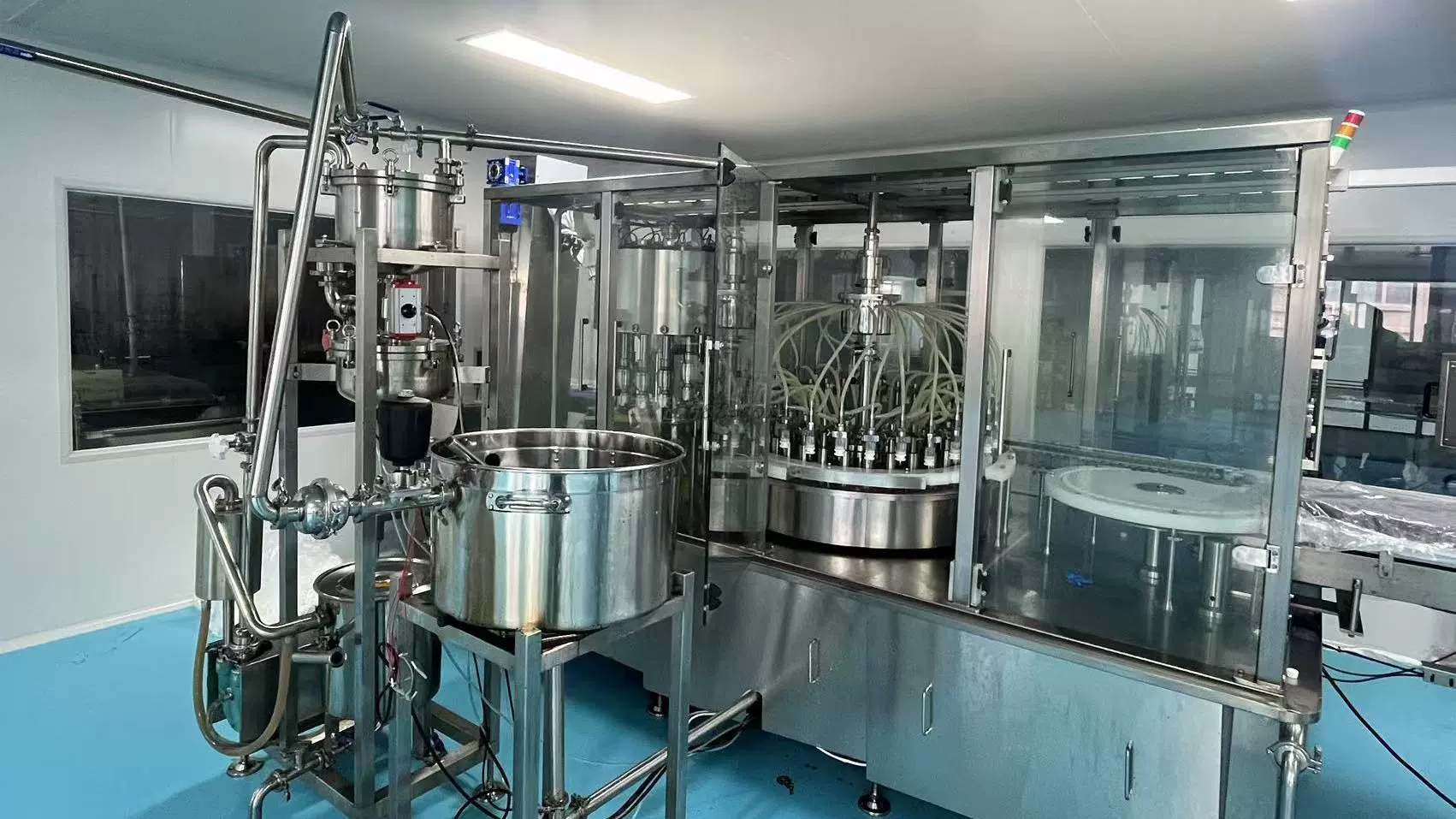
Oral liquid filtration usually runs in two stages. Pre-filtration removes coarse particles and gummy material using plate and frame, filter bags or depth cartridges. Final filtration controls fine particles and bioburden using microporous membranes. Filter material must be compatible with the liquid; polypropylene, polyethersulfone, nylon and polyvinylidene fluoride are common, and selection has to account for pH, ethanol content and temperature, since some materials leach or deform in alcoholic systems. Pore size is not a case of smaller being better: an unnecessarily fine membrane blocks quickly, retains active material and can shift the assay. Liquids carrying significant colloids or extractives suit gradient filtration, moving from coarse to fine, which protects throughput without losing effect. Once selected, compatibility and adsorption studies confirm the filter does not bind the active.
3. Integrity testing and change-out intervals
Fitting a filter is not the end of the matter. Integrity testing confirms the membrane is intact and the seal has not failed, using bubble point, diffusive flow or pressure hold, and it belongs both before and after use: before, to confirm correct installation, and after, to confirm nothing bypassed the membrane during the run. Change-out intervals should not be guessed but set from flux decay and differential pressure data and fixed during process validation. Two risks come from reusing or overrunning filters. Retained particles and microorganisms accumulate on the filter and become a secondary contamination source, and the material may leach after prolonged contact with the liquid. Both are easy to overlook and serious in consequence, so filter identity and number of uses belong in the batch record.
4. Choosing a clarification route
Besides filtration, the usual tools are centrifugation, settling, cold and heat treatment, and clarifying agents. Centrifugation removes larger particles and some colloids efficiently but does little for fine colloidal material. Settling and cold treatment let part of the material precipitate so it can be filtered off; the cost is low but it consumes time and tank capacity, and needs care with heat-sensitive systems. Clarifying agents such as pectinase, gelatin, chitosan and bentonite remove colloids through charge neutralisation and adsorptive flocculation, which works well but raises questions of residues, allergens and clean label positioning. Practice usually combines them: coarse filtration, flocculation with a clarifying agent, settling, centrifugation, then final filtration. Any change to the combination must be revalidated for assay and stability, because clarifying agents can also adsorb the active.

5. Inspection: method, people and limits
Visual inspection is the last gate. Manual inspection depends on eyesight and concentration, so it needs defined illumination, background and viewing time, with inspectors trained and periodically qualified, usually by testing detection rates against standards containing known particles. Performance falls noticeably over long sessions, so rotation and rest breaks matter. Automated inspection machines use cameras and image processing to identify particles and fill-level anomalies, giving good consistency but with particular blind spots, so they usually run alongside manual sampling. Either way, acceptance criteria and the handling of rejects must be defined, and detected particles should be classified statistically: fibres point to filters or cleaning cloths, glass splinters to washing and filling, black specks to stoppers or the environment. That classification is what drives improvement.
6. Fill accuracy and process control
Fill volume is both a compliance requirement and a cost lever. Dosing methods include time-pressure, piston, peristaltic and gravimetric, chosen according to viscosity, foaming tendency and output requirement. Liquids containing surface-active ingredients that foam need anti-foam nozzles or submerged filling. Accuracy is affected by temperature and viscosity drift, stability of feed pressure and wear at the filling head, so in-process sampling and trend monitoring are essential. Overfill deserves attention too: averaging a few percent above nominal across a year of production is a real material cost. Seal integrity after filling matters equally and should be confirmed by seal testing and visual checks, because a poor seal produces haze and microbial contamination later and undoes all the clarification work that preceded it.
Related Products
Calcium + Zinc Oral Liquid Blueberry Flavor | Zinc Gluconate Liquid Calcium Supplement for Kids OEM | Kids Liquid Calcium with High-Potency Vitamin K2 & D3 | Calcium Zinc Oral Liquid for Teens OEM
About Guangzhou Mesen Health Biotechnology Co., Ltd
Guangzhou Mesen Health Biotechnology Co., Ltd is located in the Huashan Science and Technology Park, Huadu District, Guangzhou. The company has focused on OEM and ODM services for the big health industry for nearly 20 years, operating dedicated research, production, sales and management centres, and maintaining long-term strategic partnerships with well-known Chinese medicine colleges and research institutions. Capabilities span pressed candy, gummies, capsules, solid beverages, herbal teas, plant beverages, protein powders, dietary supplements and enzyme jelly - from formulation development through contract manufacturing. For details on minimum order quantities, sampling lead times and quotations, see our manufacturing advantages and product range, or contact us for a tailored proposal.
Further Reading




