
Three-in-One Solid Beverage OEM: Creamer, Sugar and Powder Blending
The three-in-one sachet is one of the most common formats in solid beverage contract manufacturing: one portion of powder containing an instant base, a creamer and sugar, ready to drink once water is added. The structure looks simple, yet the problems are real. In the same batch, one consumer finds lumps that will not dissolve, another says it is too sweet and thin on creaminess, and a third writes in after two months that the powder has set into a hard block inside the pack. Most of these issues are not on the formulation sheet but in how three very different powders are blended, mixed and protected from moisture. This article unpacks the blending logic, the causes of caking and the levers for tuning in-cup performance.
The build: three roles, plus functional variants
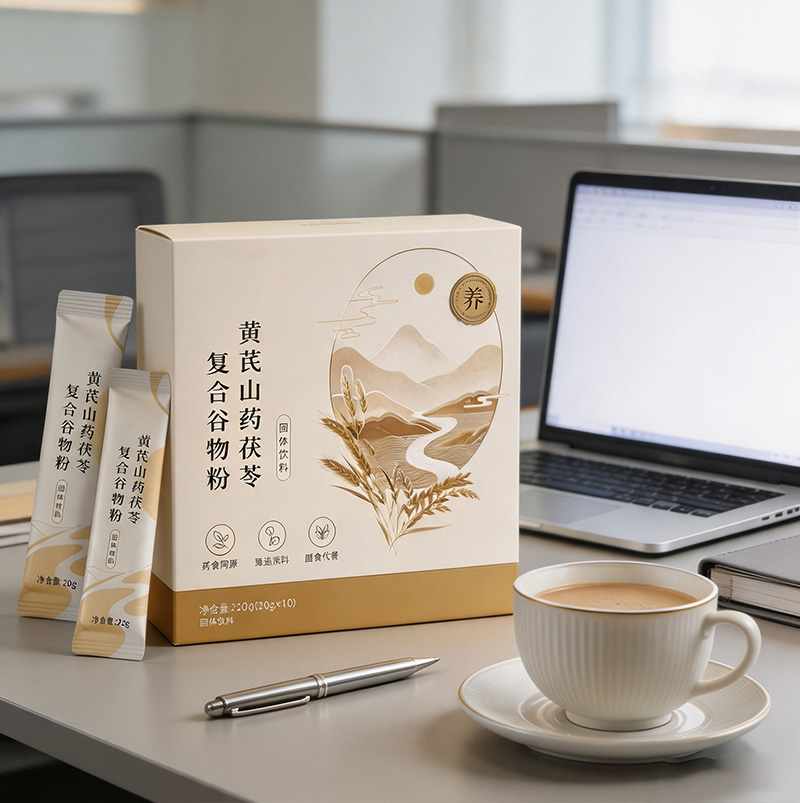
A standard three-in-one is instant base, creamer and sugar. The base carries the flavour - instant coffee, tea powder and cocoa dominate; the creamer supplies creaminess, body and whiteness; sugar delivers sweetness, bulk and the dissolving skeleton. Change the ratios and the product changes character completely. Functional variants layer on top: added fibre for body, protein for a stronger nutrition panel, sweeteners for a low-sugar claim. Every addition rebalances sweetness, viscosity and dissolution speed. Fix the positioning and the intended in-cup strength before designing anything; only then is there a baseline.
Creamer selection drives creaminess and the label
The creamer, or non-dairy creamer, is where trouble most often starts. It is built from fat, a protein carrier, emulsifiers and syrup solids. Fat level determines the richness of the cup and, equally, the cost. Low-fat creamers taste thin and watery; high-fat ones are rich but can carry a fatty note. Look at the emulsifier system too, because poor emulsification shows up as surface oil or residue on the cup. Confirm the labelling position on trans fat and saturated fat early as well. Export markets differ significantly in how they require non-dairy creamers to be declared, and choosing the wrong grade can mean redoing the whole label.

Sugar and sweetener systems: the curve matters more than the value
Sugar contributes more than sweetness: bulk, dissolution speed and mouth-filling body. Milled sugar needs a controlled particle size - coarse dissolves slowly and leaves grit at the bottom of the cup, fine picks up moisture and cakes. For reduced-sugar and sugar-free versions, blending sweeteners is the key. Single sweeteners usually carry obvious weaknesses: erythritol is weakly sweet with a cooling note, stevia leaves a bitter tail, sucralose tastes clean but adds no bulk. A workable approach combines two or three sweeteners to approximate a sucrose sweetness curve, then uses a little polyol or resistant dextrin to restore volume and body. This has to be settled by blind tasting, not by reading sweetness multiples.
Blending: density differences are the root of segregation
The three powders differ widely in density. Creamer is fluffy, milled sugar is heavier, and the instant base sits between them. Large gaps mean the blend segregates after mixing, so the composition at the start of packing differs from the end, and consumers occasionally get a sachet that is markedly sweeter or weaker. Countermeasures include narrowing particle size distributions so they sit closer together, agglomerating one component where necessary, choosing a suitable mixer and mixing time, and verifying uniformity before the blend leaves the mixer. Run packaging promptly rather than letting blend sit in the hopper. Verify uniformity by sampling the mixer at several points and the hopper at several heights and assaying marker components - not by eye.
Caking and moisture: control from room to pack
Caking is among the most common consumer complaints, and it has three layers. At the ingredient level, some components are inherently hygroscopic, notably milled sugar and several polyols. At the production level, insufficient humidity control lets powder pick up moisture whenever it is exposed. At the packaging level, inadequate barrier lets the process continue during transport and storage. The responses map accordingly: dose an anti-caking agent and adjust sugar particle size to reduce surface energy; hold the room at low humidity and shorten exposure time; select foil laminate, metallised film or cans according to the product and verify the moisture vapour transmission rate. Note that low-sugar versions usually cake more readily because they lack sugar's natural anti-caking effect, and need stricter packaging.
In-cup performance: pin the experience down with measurable parameters
Dissolution experience can be broken into four measurable parameters: dissolution speed, lump rate, residue on the cup wall, and body. Evaluate with fixed water temperature, fixed volume and a fixed stirring routine in parallel comparison rather than by impression. The usual adjustments run like this: slow dissolution calls for finer particles or agglomeration; heavy lumping points at the creamer's emulsifier system or sugar particle size; residue calls for emulsifier tuning or less total fat; thin body calls for fibre or a thickening system. Water temperature adaptability matters too - cold-water and hot-water preparation place different demands on the powder, and products meant for both need that considered at formulation stage.
The three-in-one looks like a formulation exercise but is really powder engineering plus packaging engineering. Control creamer selection, the sweetness curve, blend uniformity and moisture barrier as one system, and the product will behave through shelf life - and give consumers a reason to buy it again.
Related Products
White Kidney Bean Black Coffee Latte Powder | Instant Keto Enzyme Coffee Solid Beverage OEM Private Label | Protein Berry Meal Replacement Shake Powder | Satiety Smoothie Solid Beverage Custom OEM
About Guangzhou Mesen Health Biotechnology Co., Ltd
Guangzhou Mesen Health Biotechnology Co., Ltd is located in the Huashan Science and Technology Park, Huadu District, Guangzhou. The company has focused on OEM and ODM services for the big health industry for nearly 20 years, operating dedicated research, production, sales and management centres, and maintaining long-term strategic partnerships with well-known Chinese medicine colleges and research institutions. Capabilities span pressed candy, gummies, capsules, solid beverages, herbal teas, plant beverages, protein powders, dietary supplements and enzyme jelly - from formulation development through contract manufacturing. For details on minimum order quantities, sampling lead times and quotations, see our manufacturing advantages and product range, or contact us for a tailored proposal.
Further Reading




