Cooling Control in Enzyme Jelly OEM: Profile, Setting, Syneresis
In enzyme jelly production, cooling is often treated as an afterthought: fill the moulds, run them through the cooling tunnel, and out comes the finished product. Treat cooling as nothing more than removing heat, and two problems appear - a high breakage rate at demoulding, and weeping or stickiness after a few days on the shelf. Both trace back to the way the gel network forms, and how well it forms is decided by how fast and in what stages the product cools. In enzyme jelly OEM, the cooling profile is a process in its own right. This article takes it apart.
Cooling is not just heat removal
Gel formation is a transition from a sol state to a network structure. At high temperature the gelling molecules are dispersed as random coils. Below the gelation point, chains begin to associate through hydrogen bonding or helix aggregation to form junction zones, and as these multiply they connect into a three-dimensional network that holds water and solutes in place. The process is sensitive to the temperature path. Cool too fast and the chains are frozen before they can order themselves, so the network has uneven crosslink density, lower strength and a brittle character. Cool too slowly and the system lingers near the gelation point, with some regions already networked while others still flow, building internal stress and an uneven strength distribution. Faster is not better, and neither is slower; the rate has to match the gelling agent's behaviour.
Finding the setting window
Before designing a cooling profile, define the setting window. Its lower edge is the gelation temperature of the gelling system, where the mix begins to lose flow; its upper edge is the maximum permissible filling temperature, bounded by viscosity, fill accuracy and microbiological control. The width of the window determines how fast cooling can be. If the gap between filling temperature and gelation temperature is small, the mix starts setting the moment it leaves the filler, so nozzles block and fill weight accuracy suffers. If the gap is wide, the mix stays fluid over a broader range and the cooling profile has more room. Establish the window by cooling stepwise in small-scale trials while watching viscosity and flow, and measuring gel strength at each temperature to find the band that neither disrupts filling nor weakens the network.
Designing a staged profile
The more reliable approach splits cooling into three stages. The first is pre-cooling, which moves the mix quickly from above the gelation point down to near it, shortening residence in the hot zone to limit losses of heat-sensitive actives and preparing the product for setting. The second is the setting stage, held at or slightly below the gelation temperature with a slower rate, giving junction zones time to form in an ordered way; this stage decides network strength. The third is the strengthening stage, dropping to the target temperature so the structure stabilises and gains enough strength for demoulding and packing. Temperature, air velocity and dwell time for all three should be adjustable on the equipment and written into the process document rather than left to operator feel. Air velocity distribution inside the tunnel also matters, because mould positions near the fan cool faster than those far from it; baffles may be needed to balance the flow.
Compensating for season and equipment
The same profile does not deliver the same result in winter and summer. Ambient shop temperature changes the tunnel's inlet conditions and heat load, and in summer the product arrives carrying more heat; keep the winter settings and the result is under-cooling, breakage at demoulding and a soft finished product. Equipment condition adds variation too: over time, frost on the evaporator, declining fan efficiency and dust in the ducting all cut heat transfer. Cooling parameters therefore should not be set once and left; confirm them periodically against ambient temperature and equipment state, adjust seasonally, record the basis for the change, and bring the cooling tunnel into the preventive maintenance plan.
Tracing weeping and stickiness back to cooling
When a finished jelly weeps during shelf life, the cause is usually blamed on the formula, but cooling contributes. When crosslink density is insufficient, the system holds water less tightly, free water migrates to the surface under gravity and shows as weeping. Where cooling is uneven, the regions with weaker networks become the first places water collects, which is why weeping often starts at a few specific mould positions. Stickiness is more often linked to high surface moisture: when the surface cools much faster than the core, water migrates outward and condenses on the surface, leaving a tacky feel. To diagnose, compare the onset and severity of weeping across mould positions and batches. Weeping concentrated at particular positions points first to uneven air flow; weeping across a whole batch points back to the formula and gelling system.
Matching demoulding to cooling
Demoulding timing also depends on the cooling result. Too early and the network has not reached sufficient strength, so breakage rises; too late and the product sits in the mould long enough for the surface to dry and skin, hurting appearance and mouthfeel. The most direct way to judge timing is centre temperature and texture measurement rather than the clock alone. Moulds with shaped cavities or deep wells demand more strength and generally need a longer setting stage. Leave a stable handover between cooling and demoulding, so that shift changes or equipment waiting time do not over-cool part of the moulds and leave one batch internally inconsistent.
Cooling in enzyme jelly is not a supporting step but the stage that determines gel network quality. Find the setting window in small-scale trials, design the profile in pre-cooling, setting and strengthening stages, revise it periodically against season and equipment condition, and use centre temperature and texture data to fix demoulding timing. With those in place, the usual complaints of weeping, breakage and inconsistent texture become far less frequent.
Related Products
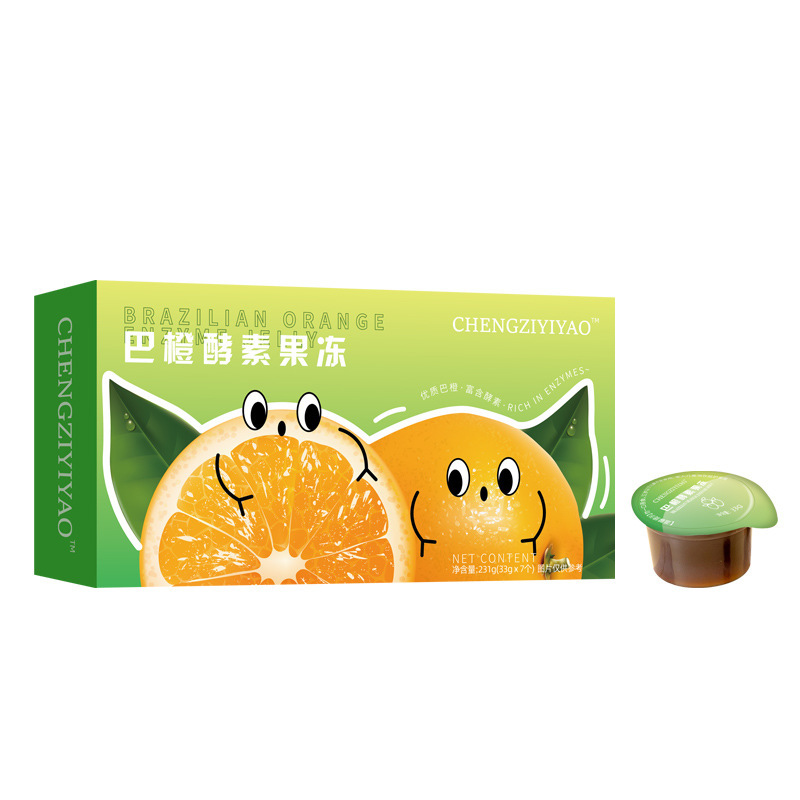
Extra Strength Orange Enzyme Jelly with Prebiotics | Fruit-Flavored Cup Jelly Private Label OEM Manufacturer | Collagen Fruit & Vegetable Enzyme Jelly with Prebiotics | Custom Extra Strength Jelly OEM Factory
About Guangzhou Mesen Health Biotechnology Co., Ltd
Guangzhou Mesen Health Biotechnology Co., Ltd is located in the Huashan Science and Technology Park, Huadu District, Guangzhou. The company has focused on OEM and ODM services for the big health industry for nearly 20 years, operating dedicated research, production, sales and management centres, and maintaining long-term strategic partnerships with well-known Chinese medicine colleges and research institutions. Capabilities span pressed candy, gummies, capsules, solid beverages, herbal teas, plant beverages, protein powders, dietary supplements and enzyme jelly - from formulation development through contract manufacturing. For details on minimum order quantities, sampling lead times and quotations, see our manufacturing advantages and product range, or contact us for a tailored proposal.
Further Reading