Label and Claim Boundaries for Oral Liquid Supplement OEM: A Compliance Guide for Brand Owners
Oral liquid is the format that looks simplest and carries the highest compliance risk. It is sold into consumption occasions tightly bound to health expectations, so packaging copy and product detail pages drift toward functional claims very easily. Under current rules, general foods may not claim any health function, and certainly may not claim disease prevention or treatment. A single line of copy over the boundary can mean delisting, an administrative penalty, or in worse cases the loss of a distribution channel for the whole brand. This article sets out where the boundaries actually sit for oral liquid supplement manufacturing.

1. Start by classifying the product
Everything else follows from this. General foods are produced under a food production licence and cannot claim health functions. Health foods require either registration or filing and the corresponding approval mark before any approved function may be claimed. Foods for special dietary uses, including foods for special medical purposes, sit behind a higher registration bar still.
The overwhelming majority of contract-manufactured oral liquids on the market are general foods. That means no matter what goes into the formula, the packaging, the detail page and the livestream script cannot say "supports immune function", "helps lower blood lipids" or "improves sleep". The recurring misconception is that if an ingredient has published research behind it, describing that effect is acceptable. The regulation constrains the claim, not the ingredient.
2. Mandatory labelling elements
The general standard for prepackaged food labelling requires the following: food name, ingredient list, net content and specification, name, address and contact details of the producer or distributor, production date and shelf life, storage conditions, the food production licence number, the product standard code, and anything else required by law or the applicable standard.
Ingredient list order is tightly prescribed: ingredients are listed in descending order of the quantity added, with ingredients at 2% or below exempted from that ordering. Compound ingredients must be broken out into their original components. Food additives must be declared under their common names as defined in the national standard. In oral liquid OEM work, the two most common reasons labels get rejected are incorrect ingredient ordering and additives written under trade or colloquial names.
3. Nutrition panel and NRV calculation
The nutrition panel follows a "1+4" pattern: energy plus four core nutrients - protein, fat, carbohydrate and sodium - are mandatory. Any nutrient that is the subject of a content or comparative claim must also be declared. NRV percentages are calculated against adult daily reference intakes, and must be derived from measured or reliably calculated values rather than estimated.
Two practical details cause trouble. Rounding intervals for NRV% are specified, and so are the "zero" thresholds: where content falls below the threshold, the value must be declared as zero rather than left blank. Protein NRV%, for instance, rounds to a 1% interval. When approving label artwork, ask the manufacturer for both the calculation basis and the laboratory report, and check that the two agree.

4. Claim boundaries: what cannot be said
It helps to sort claims into three tiers. The first tier is absolutely prohibited: any statement about disease prevention or treatment ("lowers blood sugar", "treats insomnia", "anti-cancer"), medical terminology ("prescription", "therapeutic effect", "anti-inflammatory"), and false or exaggerated superlatives ("most effective", "number one", "permanent cure").
The second tier covers health function claims that general foods may not use. There is a permitted function catalogue for registered health foods, and a general food may not borrow from it even when it contains the same raw material - nor use graphics, symbols or descriptions that would lead a consumer to believe the product has a health function.
The third tier is usable but conditional. Nutrient function claims have standard wording and may be used when the content requirement is met ("protein contributes to the growth and maintenance of muscle mass", in the appropriate regulated phrasing). Ingredients themselves can be described objectively ("contains collagen peptides"), but that description cannot lead toward an outcome. The safest operating rule is simple: describe what is in it, how much, and how to take it - never what it will do.
5. Additional exposure in e-commerce and livestream
The physical label is only the first gate. Detail pages, short video and livestream scripts fall under the same advertising and food safety rules, and they are where regulators and professional complainers concentrate their attention. Typical problems include patient testimonials or before-and-after images on the detail page, hosts making efficacy promises verbally, and customer service scripts or comment replies drifting into therapeutic descriptions.
The workable control is a documented list of prohibited terms and an approved-phrasing list, applied consistently to packaging copy, detail pages and livestream scripts. Handing this to an outsourced design agency is risky: the agency is accountable for how it looks, not for whether it is lawful.
6. Imagery is in scope too
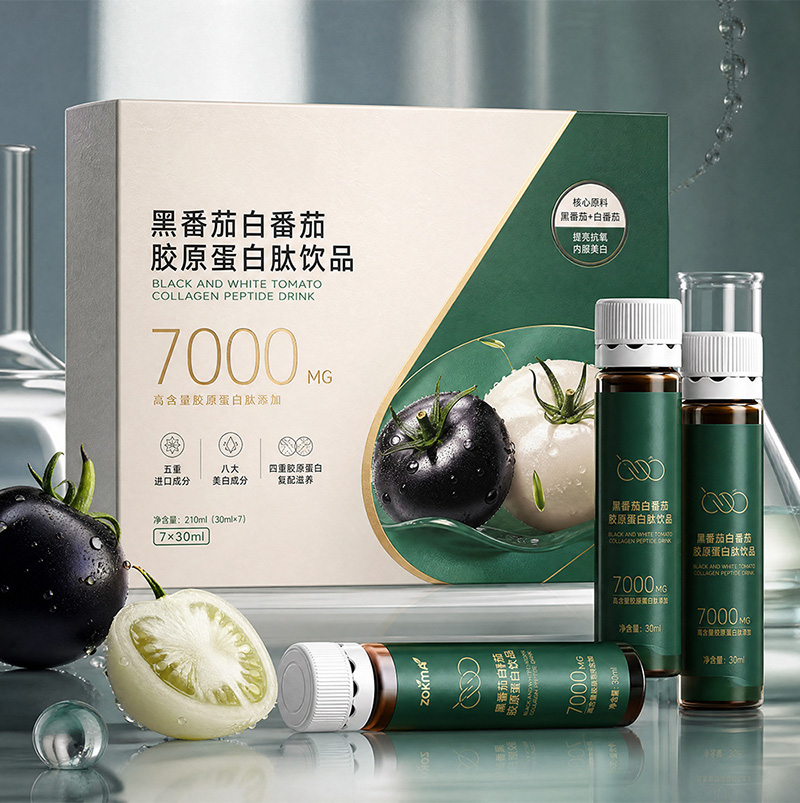
Pictures are an often-missed exposure. Doctor figures, clinical settings, prescription slips or pharmaceutical-style packaging visuals on a label or detail page can all be read as implying medical effect. Origin stories and test report screenshots need to be verifiable; charts of unknown provenance should not be used.
7. Move the review into the sampling stage
The right moment for compliance work on an oral liquid project is when the sample is approved, not when finished goods are waiting to go live. At that point the formula is frozen and three things can run in parallel: a compliance review of the label artwork, laboratory testing for the nutrition panel, and a self-audit of the detail page copy.
In oral liquid and dietary supplement programmes, Guangzhou Mesen Health Biotechnology provides a pre-clearance label review, checking ingredient ordering, additive naming, nutrition calculation and claim wording, and flagging high-risk phrasing that needs to be cut or rewritten. Compliance costs far less than a violation, and it deserves a line in both the budget and the launch timeline.
Related Products
Calcium + Zinc Oral Liquid Blueberry Flavor | Zinc Gluconate Liquid Calcium Supplement for Kids OEM | Kids Liquid Calcium with High-Potency Vitamin K2 & D3 | Calcium Zinc Oral Liquid for Teens OEM
About Guangzhou Mesen Health Biotechnology Co., Ltd
Guangzhou Mesen Health Biotechnology Co., Ltd is located in the Huashan Science and Technology Park, Huadu District, Guangzhou. The company has focused on OEM and ODM services for the big health industry for nearly 20 years, operating dedicated research, production, sales and management centres, and maintaining long-term strategic partnerships with well-known Chinese medicine colleges and research institutions. Capabilities span pressed candy, gummies, capsules, solid beverages, herbal teas, plant beverages, protein powders, dietary supplements and enzyme jelly - from formulation development through contract manufacturing. For details on minimum order quantities, sampling lead times and quotations, see our manufacturing advantages and product range, or contact us for a tailored proposal.
Further Reading