Microbial Control in Solid Beverage OEM: Powder Sterilisation and Release Testing
Among the quality risks in solid beverages, microbiology is the awkward one: unlike moisture or fill weight, it cannot be sorted or reworked once the product is made. After dosing, a dry powder system has no reliable terminal kill step, so whatever load arrives with the raw materials largely travels through to the finished pack. That puts the real battleground not on the filling line but at three gates: raw material acceptance, process design and plant environment. On the solid beverage contract manufacturing side, projects that repeatedly fail microbial limits nearly always trace back to weak incoming control or a lapse in environmental control, not to a sterilisation step that was too gentle. This article covers raw material gates, sterilisation options, plant environment, release criteria and deviation handling.
Raw materials are the first real defence
Solid beverage raw materials vary enormously in their microbiological baseline. Botanical extracts, protein powders, fruit and vegetable powders, probiotic strains and polyol excipients each behave differently. Botanical materials carry counts and heat-resistant spores influenced by growing, harvesting and drying conditions. Protein-rich materials provide nitrogen and become a favourable medium. Polyols are naturally inhibitory but turn into a contamination source once they take up moisture. The disciplined approach is to fix microbial specifications during supplier qualification, write them into the quality agreement, and test every incoming lot against a risk tier - high-risk materials lot by lot rather than on a sampling plan. Retain samples as well: when a finished product fails, being able to name the offending lot immediately saves weeks. Where a material genuinely cannot meet the internal limit, change the grade, change the supplier or restructure the formula. Do not try to compensate with a harsher kill step.
Where each sterilisation route stops working
There are four broad options and each has a boundary. Dry heat relies on high temperature over a long hold. It works against heat-resistant spores, but extended heat caramelises sugars, denatures protein and drives off flavours, so its application is narrow. Irradiation penetrates well and can treat finished packs without raising temperature, with a controllable dose, but it needs dedicated licensing and facilities, and several markets require explicit labelling, so export projects must confirm acceptance in the destination country first. Steam sterilisation uses moist heat, which is efficient, but it adds water that must be dried off again, and it is unkind to heat-sensitive or highly hygroscopic materials. Non-thermal routes such as high pressure preserve nutrients and flavour best but carry heavy capital cost and batch-size limits, so they suit high-value products. Select on material tolerance first, order volume second, market compliance third. The three are not interchangeable.
Environment and process contamination
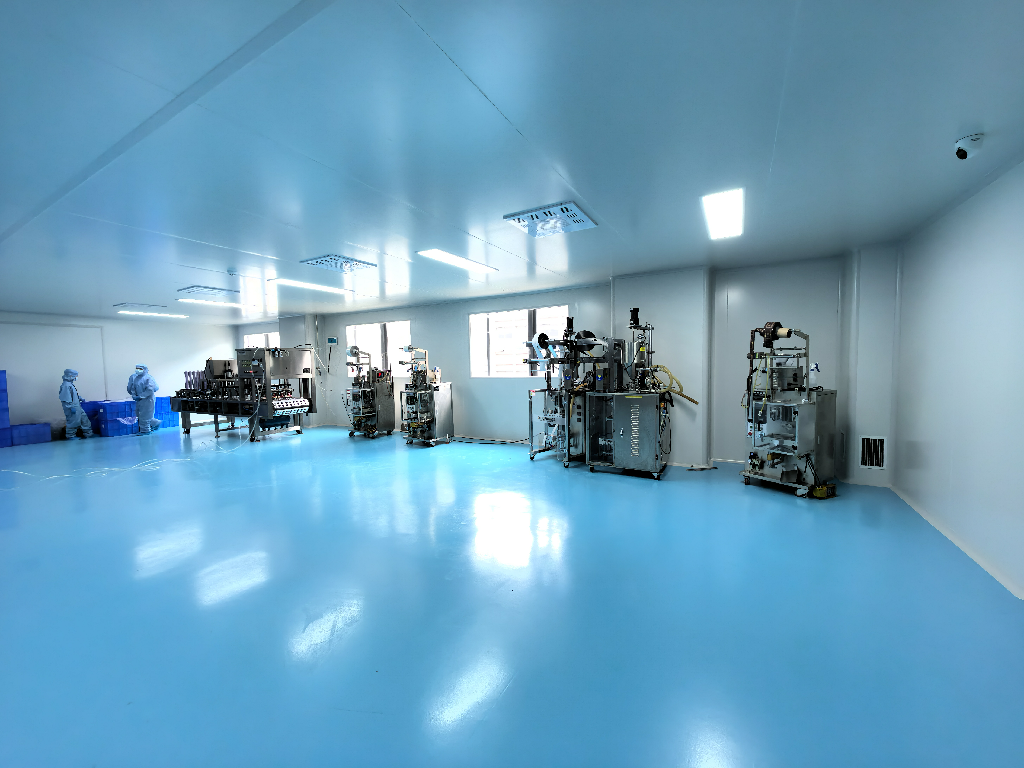
Even compliant raw materials can be re-contaminated by the room. A powder plant is a dry environment: dust stays airborne for a long time and spreads widely, so a single source can create broad cross-contamination. Key controls include positive pressure with a sensible air change rate and HEPA filtration, relative humidity held in a band that keeps hygroscopic pickup low without generating excessive static, and floors and equipment designed not to trap powder, with defined cleaning frequencies and verification methods. Personnel hygiene is routinely underestimated: gowning, hand and footwear disinfection need periodic verification, not just a sign on the wall. On equipment, blenders, granulators, sifters and ductwork hide the cleanability dead spots. Validate cleaning by sampling the hardest-to-clean locations, and set a hold time before re-cleaning is required.
How to judge finished product
Routine release testing covers total plate count, coliforms, moulds and yeasts, plus pathogen testing for particular products. Read the results in three tiers. The first tier is mandatory release: any failure is an automatic reject. The second is trend: a compliant total count that sits near the ceiling for several consecutive lots should trigger a process investigation. The third is early warning: mould and yeast numbers that swing more widely between lots usually mean environmental control is loosening. Running all three shifts attention from whether a single lot passed to whether the process is capable. Watch the method as well. Sampling approach, dilution and incubation conditions all affect the reading, so any method change needs a comparability study to avoid mistaking a method shift for a process shift.
Deviations and improvement
When a microbial result goes out, work in order. Confirm the result is valid and rule out sampling or handling error. Then pull the raw material lots, environmental monitoring and cleaning records for that batch. Re-test the retention sample to establish whether this is isolated or systematic. Assign the cause across three zones - material, process, environment. Material issues usually show as repeated high results from one supplier, answered by tighter sampling or a supply hold. Process issues usually point to incomplete cleaning, equipment dead spots or insufficient drying temperature. Environmental issues normally come with matching anomalies in environmental monitoring. Once a corrective action is in place, verify it against the next three to five lots rather than closing it on paper. Accumulate the causes by category over time and the genuine weak points of that product become obvious.
Microbial control in solid beverages is really the management of defence lines. Hold the raw material gate, choose sterilisation within material and market limits, make environmental control and cleaning validation routine, judge release in tiers so trends are visible, and drive every deviation back to a root cause with data to prove the fix. Do those five things and microbial results stop being a recurring surprise and become a limit you reliably hold.
Related Products
White Kidney Bean Black Coffee Latte Powder | Instant Keto Enzyme Coffee Solid Beverage OEM Private Label | Protein Berry Meal Replacement Shake Powder | Satiety Smoothie Solid Beverage Custom OEM
About Guangzhou Mesen Health Biotechnology Co., Ltd
Guangzhou Mesen Health Biotechnology Co., Ltd is located in the Huashan Science and Technology Park, Huadu District, Guangzhou. The company has focused on OEM and ODM services for the big health industry for nearly 20 years, operating dedicated research, production, sales and management centres, and maintaining long-term strategic partnerships with well-known Chinese medicine colleges and research institutions. Capabilities span pressed candy, gummies, capsules, solid beverages, herbal teas, plant beverages, protein powders, dietary supplements and enzyme jelly - from formulation development through contract manufacturing. For details on minimum order quantities, sampling lead times and quotations, see our manufacturing advantages and product range, or contact us for a tailored proposal.
Further Reading